Transplants and PRP: Who Is Actually a Candidate
A transplant relocates follicles you already have. It does not add any, and it cannot stop the loss around them. That single constraint decides whether surgery is a good idea.
Follicular unit transplantation takes hair-bearing skin from a permanent zone at the back and sides of the scalp and places it into areas that have lost hair. The follicles are moved, not created. Everything else in the procedure — technique, session size, hairline design — is a refinement of that single fact.
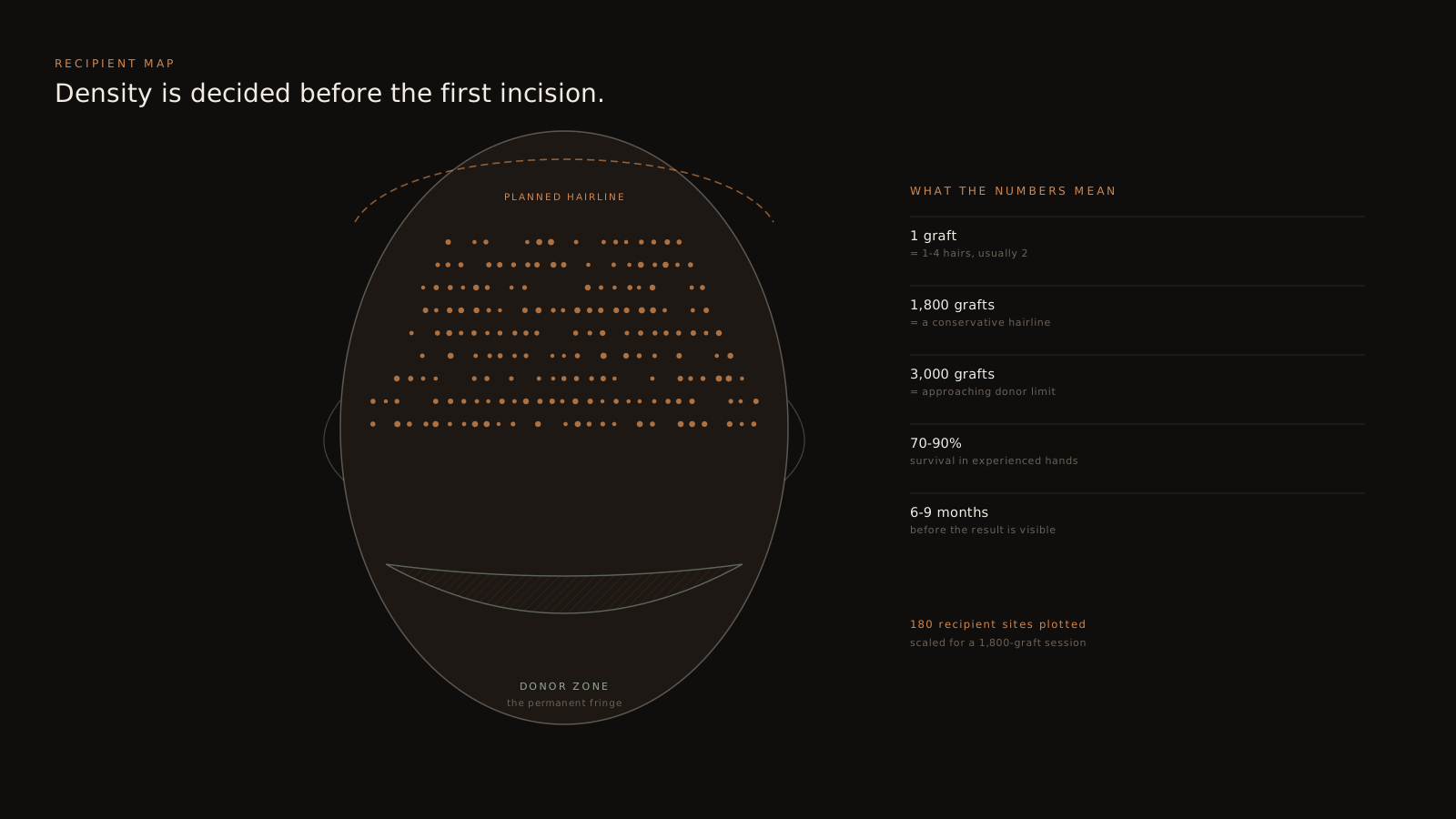
Graft survival in experienced hands is reported in the seventy to ninety per cent range, and modern techniques with careful handling and graft storage can exceed it. That is a genuinely high number and it is not the reason results disappoint. Results disappoint because the plan was wrong for the patient.
01What a graft actually is
A follicular unit is the natural grouping in which scalp hair grows, containing one to four terminal hairs with their associated sebaceous gland and supporting tissue. Most units contain two. A two-thousand-graft session therefore moves roughly four thousand hairs, and the arithmetic of coverage follows from that.
Density is measured in hairs per square centimetre. A natural frontal hairline runs around eighty; a transplanted one typically achieves forty to fifty, which is enough to look full because of the way hair layers. The number that matters for planning is total hairs available, not the graft count on the quotation.
What the evidence supports
- A graft contains one to four hairs, usually two. Total hairs, not graft count, determines what is achievable.
- Donor supply is finite and set by genetics. It is the binding constraint on every result.
- Surgery on an unstable scalp produces an island that recedes away from itself. Stability for a year first is not optional.
- PRP has small, inconsistent trials. Any claim of a large effect on density is not supported by them.
02Donor supply is the ceiling
The permanent zone contains a finite number of follicles, determined genetically and not expandable by any current treatment. A typical candidate has enough for two thousand to four thousand grafts over a lifetime, and using them all in one session at thirty is a decision that removes every option at forty-five.
This is why a surgeon's first job is to assess donor density rather than to agree with the patient about how low the hairline should go. A clinic that quotes a graft number before examining the donor area is quoting a wish.
03Why stability comes first
Pattern loss continues after surgery. Hair moved into a hairline is permanent, because it came from the permanent zone; the native hair behind it is not, and it continues to recede. The result over five to ten years is a dense band with thinning behind it, which looks less natural than the baldness it replaced.
The usual guidance is twelve months of stable loss on medical treatment before surgery, with photographic comparison rather than memory as the evidence. It is inconvenient advice, and it is the difference between a result that ages well and one that requires a second procedure to disguise the first.
04FUT and FUE
Follicular unit strip surgery removes a strip of scalp and closes it, then dissects the strip into units under magnification. Follicular unit extraction punches individual units. Both produce the same kind of graft; they differ in how it is harvested.
Strip surgery yields more grafts per session and leaves a linear scar that is hidden by hair of a certain length. Extraction leaves small dot scars distributed through the donor area and permits a very short haircut, at the cost of a lower yield per session and greater dependence on operator skill. Neither is superior in the abstract. The right choice depends on the target density, the planned hairstyle, and the donor laxity.
05PRP, described at its actual evidence level
Platelet-rich plasma is prepared from the patient's own blood and injected into the scalp. The rationale is that platelet-derived growth factors stimulate follicular activity. Trials exist, and they are small, heterogeneous in preparation method, and inconsistent in result.
The better-designed studies report modest improvements in hair count in androgenetic alopecia, often as an adjunct to minoxidil or finasteride rather than alone. The number of injections, the interval, the platelet concentration and the activation method all vary between studies, which makes pooling impossible and marketing easy.
The honest position is B bordering on C: probably a small adjunctive effect, definitely not a substitute for a drug with controlled five-year data, and expensive per session relative to either. Claims of dramatic density gains are not supported by the literature.
06Cost, and what you are buying
Pricing varies by a factor of five between markets for what is nominally the same procedure. The variable that predicts outcome is not price but the surgeon's volume and the team's handling of grafts — how long they are out of the body, at what temperature, and how much mechanical trauma they sustain during placement.
The questions worth asking are unglamorous: how many procedures does the surgeon perform per week, who places the grafts, what is the clinic's revision policy, and can they show photographic results at five years rather than five months. A clinic that cannot answer the last one is selling a photograph, not a result.
“A transplant is a permanent cure for baldness.”
The transplanted hair is permanent. The scalp around it is not. Without medical treatment the native hair continues to recede, and the surgical result becomes an isolated band. Surgery is a rearrangement, not a cure.
07Who should not have one yet
Anyone with active loss in the last twelve months, anyone whose donor density has not been measured, anyone under twenty-five without an unusually stable and well-documented pattern, and anyone with a body dysmorphic concern disproportionate to the visible loss. In the last case surgery reliably makes the concern worse, because the focus simply moves to the next perceived flaw.
For the right candidate — stable loss, adequate donor, realistic hairline, treated medically — the procedure is predictable and the satisfaction rate is high. The selection is the treatment.
References
- Rousso DE, Presti M. Follicular unit transplantation: a review of techniques and outcomes. Facial Plastic Surgery Clinics of North America. 2013;21(3):381-390.
- Shapiro R, et al. Graft survival and hair growth after follicular unit transplantation. Dermatologic Surgery. 2003;29(6):597-602.
- Gupta AK, et al. Platelet-rich plasma for androgenetic alopecia: a systematic review. Journal of the American Academy of Dermatology. 2022;86(3):628-636.
- Avram MR, et al. The potential role of platelet-rich plasma in hair restoration. Dermatologic Surgery. 2014;40(11):1225-1233.
- Unger W, Unger R. Donor area density and its influence on surgical planning. Hair Transplant Forum International. 2017;27(4):132-137.