Bond Builders: Real Chemistry, Inflated Claims
A bond builder can rebuild cross-links broken by bleach. It cannot restore the fibre's original structure, and that distinction is the difference between a treatment and a story.
Hair is mostly keratin, and keratin's mechanical properties come from cross-links: disulfide bonds between cysteine residues, hydrogen bonds, and salt bonds. The disulfide bonds are the strong ones, and they are what permanent colour, bleach and chemical straightening are designed to break.
A bond builder is a product formulated around molecules intended to form new cross-links inside the cortex. That description is accurate. The chemistry is documented, the molecules are real, and the instrumental studies are usually honest. The overreach begins at the word “repair”.
01What bleach actually does
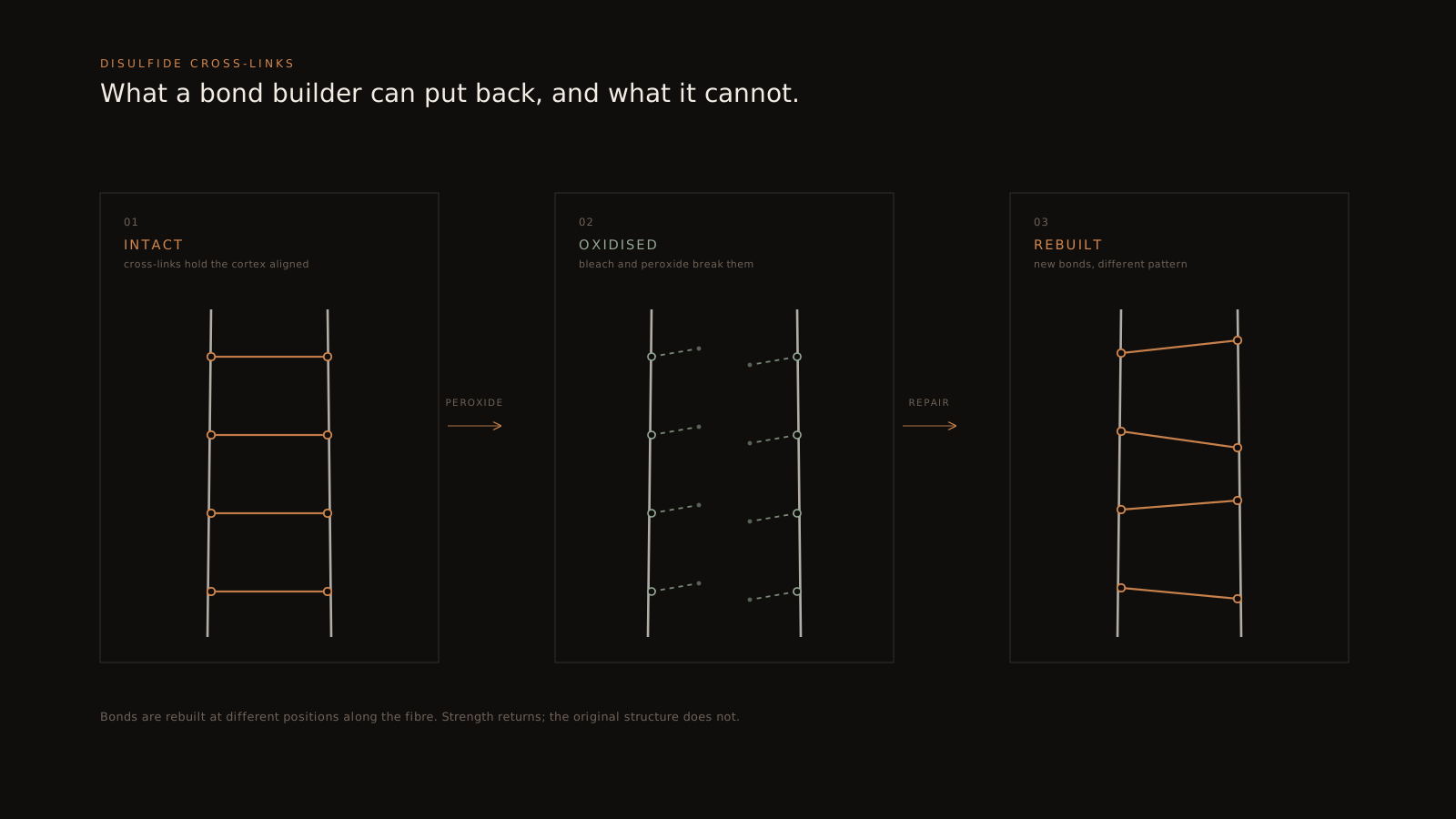
Bleaching oxidises the melanin that gives hair its colour, and it oxidises cysteine disulfide bonds along the way. Some become sulfonic acid residues, which cannot re-pair. The cortex loses cross-links, the fibre becomes more porous, and the cuticle lifts and cracks.
Two consequences follow, and only one of them is addressable. The loss of cross-links can be partly compensated by new bonds. The loss of cuticle integrity and the conversion of some cysteine to sulfonic acid cannot be reversed by anything in a bottle. Hair is dead tissue; there is no repair process, only surface treatment and cross-link substitution.
02What the molecules do
The best-documented approach uses a molecule with two reactive ends that can bond to cysteine on each side, bridging a gap where a disulfide used to be. In vitro work on bleached tresses shows measurable increases in tensile strength and reductions in breakage under combing, which is a meaningful outcome.
Other formulations use different chemistries — peptide chains, amino acid blends, pH-driven ionic interactions — with less direct evidence. The category is broad, and a product's presence in it does not guarantee the mechanism claimed on the bottle.
What the evidence supports
- Bleach and peroxide oxidise disulfide bonds in the cortex, which is what makes coloured hair weaker.
- Bond-building molecules can form new cross-links in the cortex. The chemistry is real and reproducible.
- What the studies measure is tensile strength and combing force, not the restoration of the original molecular architecture.
- The benefit is cumulative only while you keep using it, and it does not undo damage already done to the cuticle.
03What the studies measure
The instruments used are a tensile tester and a combing force rig. Both are legitimate. Neither measures “hair health”, which is not a defined quantity, and neither can show that a fibre has returned to its pre-bleach state.
The studies are also almost entirely ex vivo: tresses of hair treated in a laboratory. That is normal and appropriate for a cosmetic claim, but it means the evidence describes fibre mechanics under test conditions, not the experience of a person with mid-length coloured hair in a bathroom.
Grade C is the correct tier here, and it is not a dismissal. In-vitro mechanical data is real evidence about a real mechanism. It simply does not support the sentence most marketing uses it to support.
04Protein, moisture and the false binary
Consumer advice divides damaged hair into “protein overload” and “moisture overload”, with a diagnostic protocol of stretching a wet strand. Neither category exists in the cosmetic science literature, and the tests have not been validated against any measured property.
What is measurable is that hydrolysed proteins and conditioning polymers adsorb to the surface, reduce friction and improve feel, and that humectants increase water content in the fibre. Both are useful. Neither is a repair, and the balance between them is a formulation question rather than a personal diagnosis.
The practical advice that survives: use conditioner every time you wash, use a bond builder if you bleach, and treat the two as surface management rather than therapy.
05What to expect, honestly
If your hair is bleached, a bond builder used consistently will make it feel stronger and break less. That is worth money if breakage is your problem. The improvement is not permanent: the new cross-links degrade with further chemical processing and with time, so the effect is a maintenance regime rather than a course of treatment.
If your hair is not chemically processed, the case is much weaker. A conditioner will deliver most of the friction reduction that a bond builder delivers, at a fraction of the price, and the cross-link story does not apply to a fibre whose cross-links are intact.
“Rebuilds bonds broken by colouring, permanently restoring the hair.”
New cross-links form, and they are not in the same positions. The fibre is measurably stronger; it is not structurally identical to what it was. “Permanent” is also wrong: the new bonds are broken by the next round of bleach.
06The verdict
Bond builders are the most interesting thing to happen in hair cosmetics in twenty years, and the least honestly described. Buy one if you bleach and you break. Expect stronger-feeling hair, not restored hair, and expect the effect to end when you stop.
Do not buy one to fix hair that was never chemically damaged. There is no bond to build.
References
- Robbins CR. Chemical and Physical Behavior of Human Hair. 5th ed. Springer; 2012.
- Gavazzoni Dias MF. Hair cosmetics: an overview. International Journal of Trichology. 2015;7(1):2-15.
- Takahashi T, et al. Improvement of hair tensile properties by a bis-aminoethyl maleimide cross-linker. Journal of Cosmetic Science. 2019;70(4):219-231.
- Marsh JM, et al. Hair colouring and the mechanical properties of the fibre: a review. International Journal of Cosmetic Science. 2020;42(2):118-126.