How Often You Wash Is Not a Medical Question
Washing frequency is a comfort decision with a cosmetic outcome. Almost everything said about it in beauty coverage implies a physiological mechanism that does not exist.
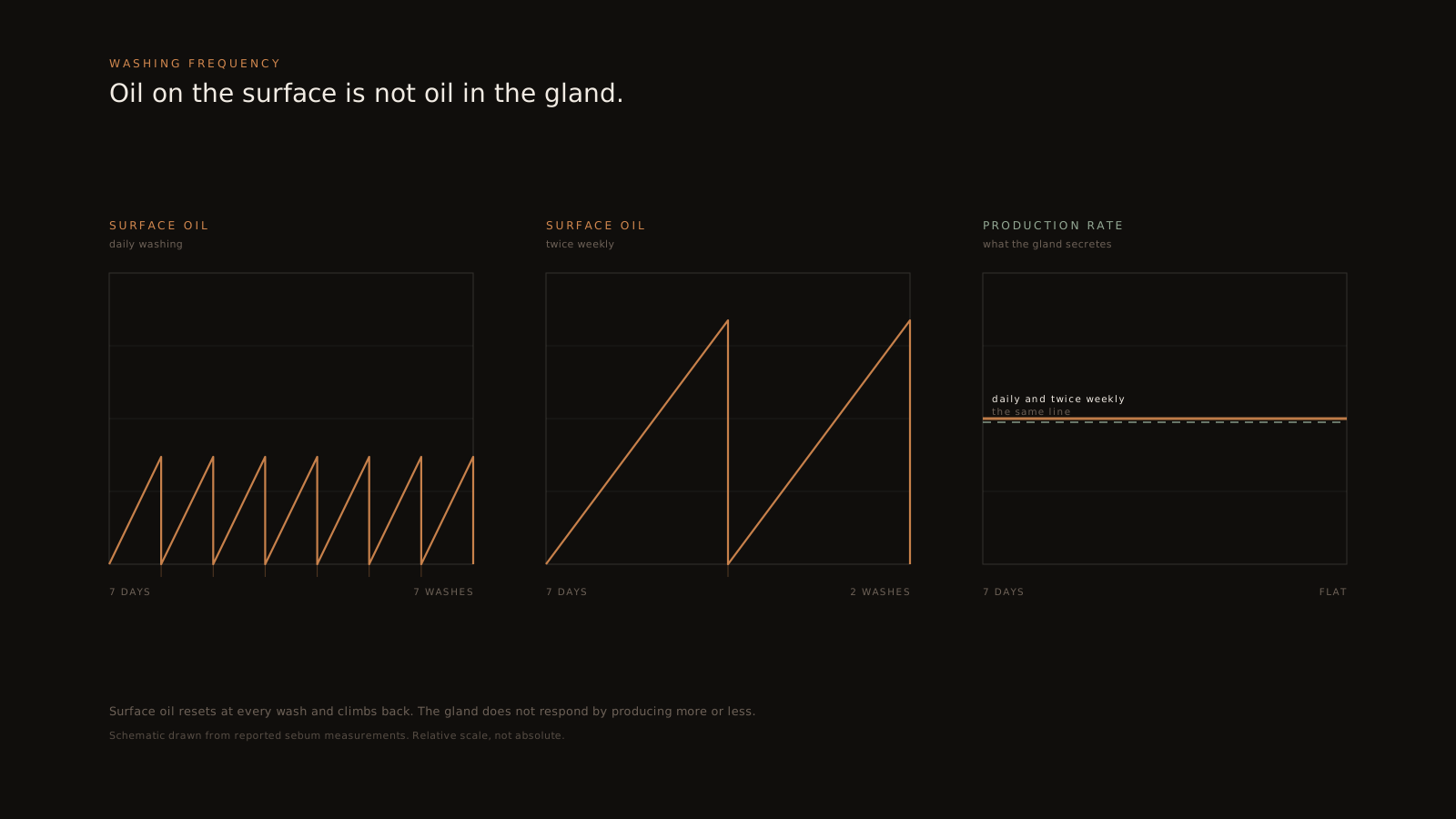
There is a durable belief that washing your hair too often makes it oilier, because the scalp “compensates” by producing more sebum. It is stated as fact in most beauty coverage and it is the basis for an entire genre of advice about “training” your hair to be washed less.
The belief is testable, and it has been tested. Sebum production is regulated by androgen activity and by the sebaceous gland's own biology. Removing oil from the surface does not signal the gland to make more, because the gland has no mechanism for sensing surface oil loss and no feedback loop to respond to it.
01What actually happens when you wash less
The confusion comes from a real observation with the wrong explanation. People who extend the interval between washes do find that their hair becomes manageable on day three instead of day one. That is not adaptation. It is accumulation: with less frequent removal, the residual oil film is thicker at any given moment, and hair that is slightly oiled lies flatter and looks less frizzy.
Sensory adaptation is the second half. Scalp oiliness is perceived relative to what you are used to. After a few weeks of washing twice weekly, a day-three scalp no longer feels remarkable.
What the evidence supports
- Sebum production is under hormonal and genetic control. It does not increase to compensate for washing.
- Sulfates are effective surfactants with a well-characterised irritation profile. Whether they suit you is a skin question, not a safety one.
- The float test and the “stretch test” are not measurements. Hair porosity is a research variable, not a home diagnostic.
- Wash as often as your scalp is comfortable. There is no correct number, and no evidence that frequent washing damages hair that is not already damaged.
02Sulfates, without the moral panic
Sodium lauryl sulfate and sodium laureth sulfate are anionic surfactants. They are extremely effective at lifting sebum, which is the actual purpose of shampoo. They also bind skin proteins and can disrupt the stratum corneum, which is why they sting if they get in your eyes and why they irritate some scalps at higher concentrations.
That is a genuine and well-characterised irritation profile, not a toxicity story. The relevant question is whether a given formulation irritates your scalp, and a milder surfactant system — cocamidopropyl betaine, glucosides, isethionates — answers it. The claim that sulfates “strip” hair into permanent damage is not supported: hair is not living tissue, and the cuticle changes they cause are cosmetic and reversible with conditioning.
One population has a real reason to be careful: people with eczema, psoriasis or a recently coloured or chemically straightened head. For everyone else the choice is about feel and scalp comfort.
03Is there an evidence-based frequency?
No. There is no trial establishing an optimal washing interval, and there could not easily be one, because the outcome is cosmetic and the tolerance varies enormously with sebum rate, hair texture, climate, exercise and occupation.
The dermatological guidance that does exist concerns seborrheic dermatitis, where medicated shampoo contact time matters far more than frequency, and where washing daily during a flare is actively useful. Outside that, the reasonable rule is: wash when your scalp is uncomfortable or your hair looks the way you do not want it to look.
The one genuine caution concerns already-damaged hair. Repeated wetting and drying causes cuticle swelling and mechanical wear, and very frequent washing of bleached hair without conditioning increases breakage. That is a hair-fibre problem, not a scalp problem, and the fix is conditioner and gentler handling rather than fewer washes.
04The float test is not a measurement
A strand of hair placed in a glass of water will float, then sink slowly, then sink quickly, depending on its density, its surface treatment and how long you wait. The claim that this reveals “low, normal or high porosity” is not supported by any validation study, because there is no standard method to validate it against.
Porosity in the research literature is measured by gas adsorption or by water uptake under controlled conditions, and it is a fibre property of interest to formulators. It is not a category a consumer can usefully act on, and the widely shared advice derived from it — that high-porosity hair needs protein and low-porosity hair needs moisture — has no trial support in either direction.
The practical consequence: if your hair feels rough and breaks, it is damaged, and the response is conditioning and less mechanical stress. You do not need a diagnostic to arrive at that.
05What conditioning actually does
Conditioners work on the surface. Cationic surfactants adsorb to the negatively charged hair surface, reducing static and friction; fatty alcohols and silicones fill and smooth cuticle edges, which increases light reflection and reduces combing force.
Reduced combing force is the mechanism that prevents breakage, and it is measurable. This is why conditioner is the single most effective intervention for hair that breaks, and why it matters more than the shampoo you choose. A cheap conditioner used consistently outperforms an expensive shampoo used alone.
06The short version
Wash as often as your scalp is comfortable. Choose a surfactant system that does not irritate you and a conditioner you will actually use. Ignore claims about training, rebound and porosity testing, not because they are harmless folklore but because they lead people to buy products that address a mechanism that does not exist.
References
- Draelos ZD. The science behind skin care: cleansers. Journal of Cosmetic Dermatology. 2018;17(1):8-14.
- Robbins CR. Chemical and Physical Behavior of Human Hair. 5th ed. Springer; 2012.
- Gavazzoni Dias MF. Hair cosmetics: an overview. International Journal of Trichology. 2015;7(1):2-15.
- Schwartz JR, et al. Role of surfactants in shampoo mildness. Journal of the Society of Cosmetic Chemists. 2019;70(3):145-158.
- Sinclair R. Healthy hair: what is it? Journal of Investigative Dermatology Symposium Proceedings. 2007;12(2):2-5.