Androgenetic Alopecia: What Actually Slows It Down
Pattern hair loss is a genetic sensitivity to a normal hormone. That is why the treatments that work are unglamorous, slow, and permanent as long as you keep using them.
Androgenetic alopecia is the most common form of hair loss in both sexes, and the most reliably misrepresented. It is not caused by poor circulation, clogged follicles, shampoo residue or wearing a hat. It is caused by a genetically inherited sensitivity of certain follicles to dihydrotestosterone, a metabolite of testosterone present in everyone.
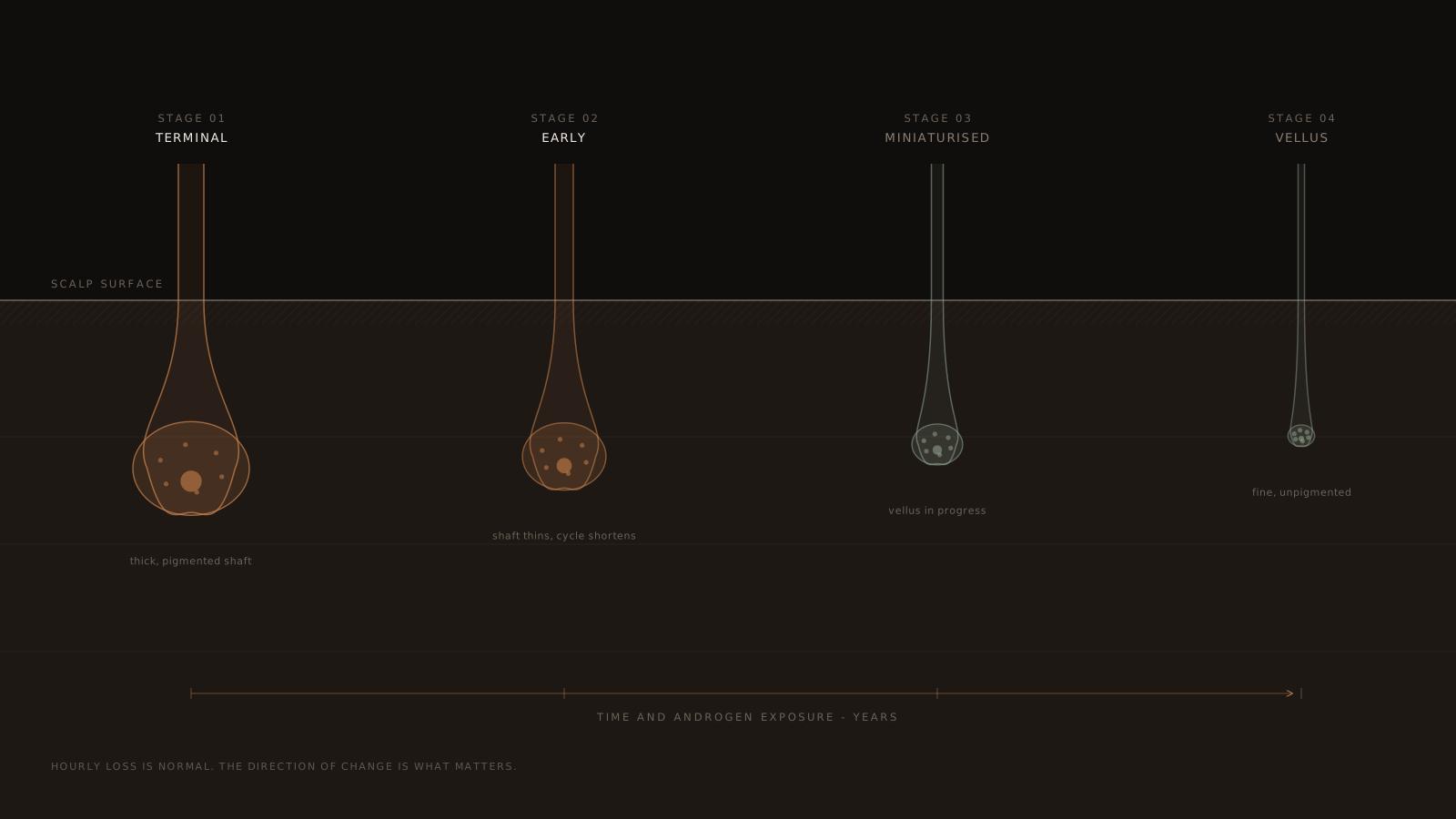
The follicle does not die. It miniaturises: the growth phase shortens, the shaft thins, and over successive cycles the follicle produces a fine, unpigmented hair before eventually producing nothing visible at all. This is why timing dominates every other variable. A miniaturised follicle can be pushed back toward normal. A follicle that has already produced vellus hair for years usually cannot.
01The mechanism, briefly
Testosterone is converted to dihydrotestosterone by the enzyme 5-alpha reductase type 2, which sits in the dermal papilla at the base of the follicle. In susceptible follicles — determined by inherited variation around the androgen receptor gene — dihydrotestosterone shortens anagen, the growth phase, and lengthens the resting phase.
Two details matter clinically. First, circulating hormone levels in most people with pattern loss are entirely normal; a blood test showing normal testosterone tells you nothing about why the hair is thinning. Second, the sensitivity is local and patterned, which is why hair recedes at the temples and thins at the crown while beard and body hair, which respond to the same hormone in the opposite direction, may increase.
02What the trials measure, and what they do not
Most registration trials for these drugs report change in non-vellus hair count in a one-centimetre target area, photographed and counted under controlled conditions. The numbers are unglamorous: a mean gain of ten to twenty hairs per square centimetre over twelve months, against a placebo group that continues to lose hair.
That gap is the real result. A treated group that holds steady while an untreated group declines produces a large between-group difference without producing visible regrowth on any individual head. This is why a patient who expects thickening is often disappointed while the trial is counted a success. Holding ground in a progressive disease is the outcome.
What the evidence supports
- Pattern loss is driven by follicle sensitivity to dihydrotestosterone, not by circulating testosterone levels.
- Topical minoxidil and oral finasteride are the two interventions with grade A evidence. They work by different mechanisms and combine.
- Both take four to six months to show, and both reverse within a year of stopping. That single fact explains most reported failures.
- Nothing applied to the scalp restores a follicle that has already become vellus. Earlier is the whole game.
03Minoxidil
Topical minoxidil began as an oral antihypertensive and was repurposed when patients reported hair growth as a side effect. Its mechanism in the follicle is still not fully settled; the leading account is that it prolongs anagen partly through potassium channel opening and improved perifollicular blood flow.
The evidence is strongest for five percent foam or solution applied twice daily. Once-daily five percent foam performs comparably to twice-daily two percent solution in trials, which matters because adherence is the binding constraint. Response typically begins at twelve to sixteen weeks and plateaus around twelve months.
Two practical points that trials under-report. The vehicle — propylene glycol in the solution — causes contact irritation in a meaningful minority; the foam avoids it. And shedding in the first six weeks is common and expected: it reflects follicles shifting from rest into a new growth phase, not the treatment failing. Most people who abandon minoxidil do so in exactly that window.
04Finasteride and dutasteride
Oral finasteride one milligram inhibits type 2 5-alpha reductase, lowering scalp dihydrotestosterone by roughly sixty percent. It is the more mechanistically direct of the two drugs and the one with the longest follow-up: controlled data extend past five years, with treated groups maintaining hair count while placebo groups decline steadily.
Dutasteride inhibits both type 1 and type 2 isoforms and lowers scalp dihydrotestosterone further. It is used for pattern loss in some countries and not approved for it in others. The comparative evidence against finasteride is limited, and the difference in effect size, while real in pharmacokinetic terms, is modest in photographs.
Sexual side effects are the reason many people never start. Pooled trial data put them at a low single-digit percentage, only slightly above placebo, and most resolve on continuation or discontinuation. Post-marketing reports describe persistent symptoms in a small number of users, a phenomenon that remains contested and poorly characterised in controlled data. It should be part of the conversation, described at its actual magnitude in both directions.
05The adherence problem is the whole problem
Both drugs are chronic, not curative. Stop finasteride and the benefit reverses over six to twelve months; the underlying sensitivity was never removed. Stop minoxidil and the same happens faster.
This produces the most common failure mode in clinic: a patient tries a treatment for eight weeks, sees no change, stops, and reports that it did not work. Eight weeks is before the earliest measurable response. The correct trial period is six months, and the correct expectation is stabilisation rather than regrowth.
“You have to keep using it forever, so it is not a real treatment.”
The dependence is real and it is not unique. Blood pressure medication works the same way. A treatment that suppresses a process works only while it is present. The honest framing is not that the drug fails, but that the disease is ongoing and the drug is a control, not a cure.
06What has no evidence behind it
The category is large. Scalp massage, microneedling as monotherapy, caffeine shampoos, biotin in people without deficiency, onion juice, rosemary oil at cosmetic concentrations, laser combs sold without trial data, and the entire genre of “hair growth” supplements that list thirteen vitamins at sub-therapeutic doses.
Some of these have a plausible mechanism and one small study. Mechanistic plausibility is exactly what grade C means, and it is why the tier exists. Microneedling combined with minoxidil has a handful of small trials suggesting an additive effect; microneedling alone does not. Rosemary oil has one small comparative trial against two percent minoxidil with a modest result and methodological limits. Neither is a substitute for a drug with five-year controlled data.
07When a transplant enters the conversation
Surgery moves follicles; it does not create them, and it does not stop the loss around them. A transplant performed on an unstable scalp produces a dense island that recedes away from itself within a few years, which is the single most common reason a result looks wrong at year five.
The reasonable sequence is medical treatment first, stability for at least a year, then surgery to restore what has already been lost. That ordering is unglamorous and it is not what most clinics advertise, because the drug has no margin and the procedure does.
References
- Kaufman KD, et al. Long-term finasteride treatment maintains hair count over 5 years. Journal of the American Academy of Dermatology. 2008;59(5):757-764.
- Olsen EA, et al. Five percent topical minoxidil foam once daily versus two percent solution twice daily. Journal of the American Academy of Dermatology. 2007;57(5):767-774.
- Mella JM, et al. Efficacy and safety of finasteride therapy for androgenetic alopecia: a systematic review. Archives of Dermatology. 2010;146(10):1141-1150.
- Gupta AK, et al. Dutasteride in androgenetic alopecia: a systematic review of controlled studies. Journal of the European Academy of Dermatology and Venereology. 2021;35(4):846-857.
- Mirmirani P. Hormonal changes and hair loss: what the evidence supports. Dermatologic Clinics. 2019;37(2):119-127.