Flaking Is a Yeast Problem More Often Than a Dryness Problem
The instinct to treat a flaking scalp with more oil is usually the wrong instinct. The mechanism is a lipid-dependent yeast, and the treatment is an antifungal with adequate contact time.
A flaking scalp is usually treated as a dryness problem, and the response is to add oil, reduce washing and buy a shampoo described as nourishing. For the commonest cause of flaking, that is close to the opposite of what works.
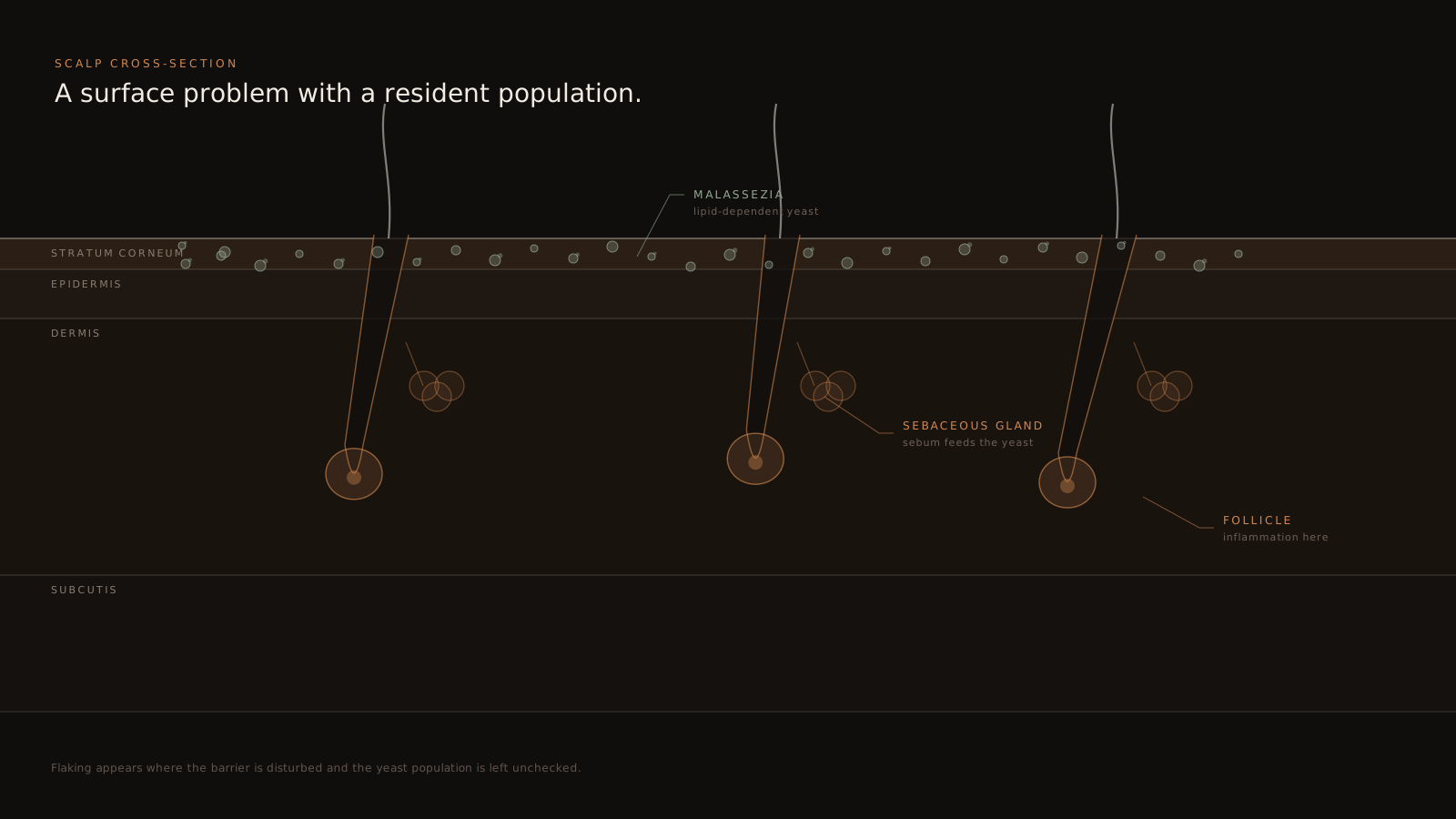
Dandruff and seborrheic dermatitis are the same disease at different severities. Both involve Malassezia, a genus of lipid-dependent yeast that lives on the scalps of essentially all adults. The difference between a mild flake and an inflamed, itchy, erythematous scalp is the intensity of the immune response to it, not the presence of the organism.
01The organism, and why it is there
Malassezia cannot synthesise its own fatty acids and depends on sebum for lipids. It is therefore concentrated where sebaceous glands are densest: the scalp, the eyebrows, the sides of the nose, the chest and the upper back. That distribution is why seborrheic dermatitis appears in exactly those places and nowhere else.
The yeast produces lipases and phospholipases that break down sebum into free fatty acids and other metabolites. Those metabolites are irritant, and in susceptible people they provoke a local inflammatory response. The visible result is flaking, redness and itch, and the flaking worsens when the scalp is occluded by oil or by infrequent washing.
What the evidence supports
- Dandruff and seborrheic dermatitis are the same condition at different severities, driven by Malassezia and the immune response to it.
- Ketoconazole, zinc pyrithione, selenium sulfide and coal tar all have controlled trial support. Contact time matters more than concentration.
- Most failures are failures of duration or contact time, not of the active chosen.
- If a well-used antifungal has not worked in eight weeks, the diagnosis is more likely wrong than the product.
02The actives that have trial data
Four have controlled evidence and a long safety record. They differ in potency, in resistance profile, and in how much they dry the scalp — but all of them require the same thing to work: several minutes of contact with the scalp, two to three times a week.
| Active | Evidence | Contact | Notes |
|---|---|---|---|
| Ketoconazole 2% | Strong | 3-5 min | Prescription in some markets; best-studied |
| Zinc pyrithione | Strong | 3-5 min | Widely available; mild |
| Selenium sulfide | Good | 3-5 min | Drying; useful in rotation |
| Coal tar | Moderate | 5-10 min | Odour and staining; effective |
| Salicylic acid | Adjuvant | 3-5 min | Lifts scale; not antifungal |
| Tea tree oil | Small trials | 3-5 min | Irritant at high concentration |
Ketoconazole is the most studied and remains the reference standard. Zinc pyrithione is nearly as effective for mild to moderate flaking and is available without a prescription in most markets. Selenium sulfide is a reasonable rotation partner. Coal tar works and smells like it.
03Contact time is the whole trick
An antifungal shampoo used as a shampoo — lathered, rinsed within thirty seconds — does almost nothing. The active needs minutes on the skin to penetrate the stratum corneum and reach the yeast. This is the single most common reason a medicated shampoo is reported as ineffective.
The workable routine: wet the scalp, apply, massage in, and then do something else for five minutes. Shave, or wash the rest of yourself. Rinse last. Two to three times a week is enough during a flare; once weekly maintains.
04Rotation, resistance and the eight-week rule
Malassezia does not develop resistance to azoles the way bacteria develop resistance to antibiotics, but response does attenuate with prolonged single-agent use, and rotating between classes is common practice. Rotating also lets you use a drying active less often.
Give any regimen eight weeks of correct use before judging it. If a properly applied antifungal used twice weekly for eight weeks has not reduced flaking, the more likely explanation is that the diagnosis is wrong — psoriasis, contact dermatitis, tinea capitis or lichen simplex are the usual alternatives — than that a different bottle will work.
05When shampoo is not enough
Widespread erythema, thick adherent scale, involvement of the eyelids or the external ear canal, or flaking that extends well beyond the oily zones warrants assessment. So does sudden severe onset in an adult, and any scaling in a child, where tinea capitis must be excluded before anything else.
Topical corticosteroids are used for short courses to settle inflammation while an antifungal does the work. They are not a maintenance treatment, and using them alone reliably produces a flare on stopping, because the yeast is still there.
06The dryness misunderstanding
Flakes look like dry skin and are not. A flaking scalp is usually an oily one, and adding oil to it feeds the organism that causes the problem. This is why “nourishing” scalp oils so often make dandruff worse within a week.
The exception is a genuinely dry, tight scalp with fine white powder — usually a barrier problem from over-washing with harsh surfactants — and that does respond to emollients and less frequent washing. The two look similar in a mirror and are distinguished by whether the flakes are greasy and yellowish or fine and dry, and by whether the scalp itches.
References
- Borda LJ, Wikramanayake TC. Seborrheic dermatitis and dandruff: a comprehensive review. Journal of Clinical and Investigative Dermatology. 2015;3(2):10.
- Pierard-Franchimont C, et al. A comparative study of ketoconazole and zinc pyrithione shampoos. Skin Pharmacology and Applied Skin Physiology. 2002;15(6):414-420.
- Schwartz JR, et al. Treatment of dandruff and seborrheic dermatitis: a review of the evidence. Journal of the American Academy of Dermatology. 2006;54(5):S168-S174.
- Dessinioti C, Katsambas A. Seborrheic dermatitis: etiology, risk factors and treatments. Clinics in Dermatology. 2013;31(4):343-351.
- Saunte DM, et al. Malassezia infections in skin disease. Journal of Fungi. 2020;6(4):253.