The Shed That Arrives Three Months Late
A diffuse shed that starts in November usually has its cause in August. Understanding that lag is most of the diagnosis, and it is the reason reassurance is often the correct treatment.
A patient describes losing handfuls of hair in the shower for three weeks. The scalp looks normal, the part is not widening in a pattern, and the shedding is evenly distributed. This is the classic presentation of telogen effluvium: a diffuse, non-scarring, usually self-limiting increase in the proportion of follicles resting rather than growing.
It is the most common cause of diffuse hair loss and, by a distance, the one most often subjected to tests that do not alter management. Understanding why requires knowing how the hair cycle responds to a systemic insult.
01Why the shed is late
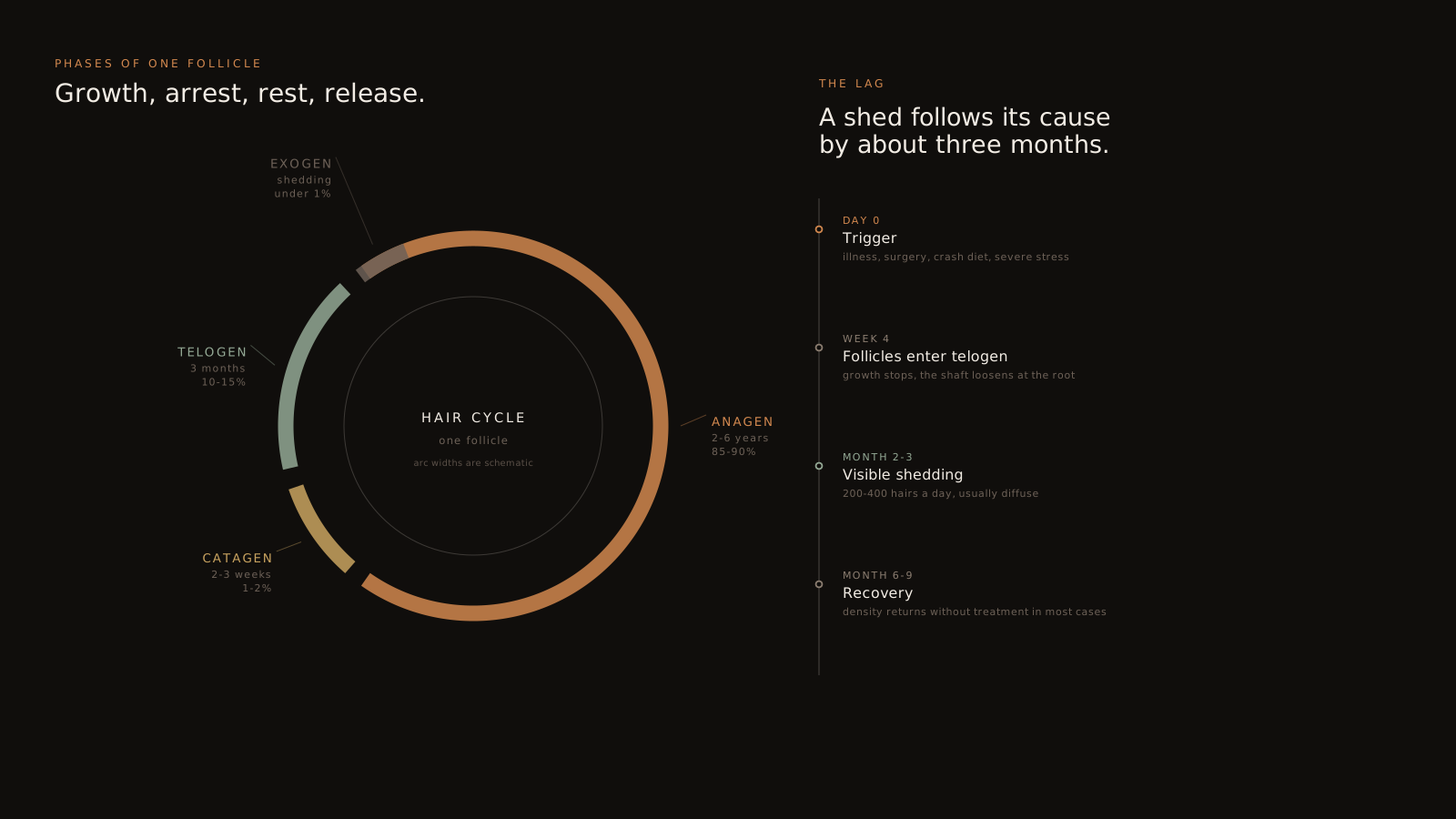
At any time, roughly one in ten scalp follicles is in telogen, the resting phase, and will shed its shaft within about three months. A systemic stressor — a febrile illness, surgery under general anaesthetic, a crash diet, childbirth, a severe emotional event — can push a much larger cohort of follicles into telogen at once.
Those follicles still have to complete the phase. The shedding therefore begins eight to twelve weeks after the trigger and peaks around month three. By the time the patient notices, the cause is usually two to three months in the past, and the recent week they are most worried about is almost always irrelevant.
What the evidence supports
- Telogen effluvium is diffuse, temporary and provoked. It is not pattern loss, and it does not scar.
- The shed lags the trigger by roughly three months, which is why the search for a cause looks backwards, not at the week it started.
- Ferritin, thyroid function and, in women with irregular cycles, androgens are the tests worth paying for. A broad panel usually is not.
- Recovery is the default within six to nine months. Treatment is mostly time, plus correcting a genuine deficiency if one exists.
02What counts as normal loss
The often-quoted figure of a hundred hairs a day is an average with a wide spread; normal ranges in the literature run from fifty to a hundred and fifty depending on hair length, washing frequency and season. Long hair sheds the same number of hairs and looks like far more in the drain.
What matters is the change, not the number. A patient who normally loses thirty hairs on wash day and now loses two hundred has a real event even if two hundred is within the population range. This is why a careful history beats any single count.
03The examination that costs nothing
A gentle pull test — grasping about sixty hairs across four areas of the scalp and applying steady traction — releases more than six hairs in an active effluvium. A trichoscopy view shows empty follicles and a high proportion of small, regrowing hairs.
The pattern matters more than the manoeuvre. Diffuse loss across the whole scalp points to telogen effluvium. Loss concentrated at the temples and crown, with hairs of varying calibre in the same area, points to androgenetic alopecia. Patchy smooth areas point elsewhere entirely and need urgent assessment. These distinctions are made with the eyes and a history, not with a blood panel.
04Which tests are worth paying for
Three are defensible: serum ferritin, thyroid stimulating hormone, and — in women with irregular cycles, acne or hirsutism — a free androgen index. Each has a plausible mechanism and a management consequence if abnormal.
The rest of the standard panel rarely changes anything. Zinc, vitamin D, vitamin B12 and a full blood count are reasonable if there is a clinical reason to suspect deficiency, but ordering them as a routine bundle for a shed produces incidental findings that generate anxiety and further testing without altering the plan.
| Test | Rules out | Changes management? |
|---|---|---|
| Ferritin | Iron deficiency without anaemia | Yes, if low |
| TSH | Thyroid dysfunction | Yes, if abnormal |
| Free androgen index | Hyperandrogenism in women | Yes, if raised |
| Vitamin D | Deficiency | Sometimes |
| Zinc, B12 | Deficiency | If suspected |
| Full hormone panel | Nothing specific | Rarely |
| Scalp biopsy | Scarring alopecia | Not for this pattern |
05The ferritin threshold problem
Laboratory normal ranges for ferritin typically start around fifteen micrograms per litre. For hair, that threshold is too low. The tissue requirement for a follicle in anagen is higher than the requirement to keep haemoglobin normal, and trichology practice generally treats a ferritin below thirty, and often below forty, as worth correcting in a patient with active shedding.
This is a clinical judgement rather than a settled guideline, and the trials are small. But iron repletion in a person with a ferritin of eighteen and a three-month shed is low-risk, cheap, and sometimes clearly effective. Iron supplementation in someone with a ferritin of two hundred is none of those things.
06Recovery, and what treatment actually is
In a provoked telogen effluvium with the trigger removed, regrowth begins as the follicles re-enter anagen, typically around month four to six, and density approaches baseline by month nine. The shedding does not stop abruptly; it tapers.
Treatment is therefore mostly time, plus correction of a genuine deficiency, plus stopping whatever is perpetuating the trigger — an ongoing crash diet, an unmanaged thyroid condition, a medication that can be substituted. There is no topical that shortens telogen.
The exception is a shed superimposed on pattern loss, which is common and frequently missed. In that case the effluvium resolves and the underlying decline continues, and the patient experiences it as a shed that never fully recovered. That is the scenario in which medical treatment for androgenetic alopecia belongs in the plan.
07When it does not resolve
Persistent diffuse shedding beyond twelve months, with no identifiable trigger and normal investigations, is classified as chronic telogen effluvium. It is poorly understood, it fluctuates, and it does not progress to baldness. It also does not respond reliably to anything.
The honest management is longitudinal: photograph the same area under the same lighting every three months, treat any deficiency, address pattern loss if present, and avoid stacking unproven therapies on top of an unproven diagnosis. Most people improve. A minority do not, and pretending otherwise wastes their money.
References
- Headington JT. Telogen effluvium: new concepts and review. Archives of Dermatology. 1993;129(3):356-363.
- Harrison S, Bergfeld W. Diffuse hair loss: its triggers and management. Cleveland Clinic Journal of Medicine. 2009;76(6):361-367.
- Trost LB, et al. The diagnosis and treatment of iron deficiency and its potential relationship to hair loss. Journal of the American Academy of Dermatology. 2006;54(5):824-844.
- Malkud S. Telogen effluvium: a review. Journal of Clinical and Diagnostic Research. 2015;9(9):WE01-WE03.
- Whiting DA. Chronic telogen effluvium. Dermatologic Clinics. 1996;14(4):723-731.